
O-Ring Temperature & Oil Resistance Comparison Chart
Two reference charts covering 18 elastomer families — operating temperature range (standard and special compounds) and resistance to ASTM No.3 mineral oil. Use them together to shortlist a compound before checking the detailed material page.
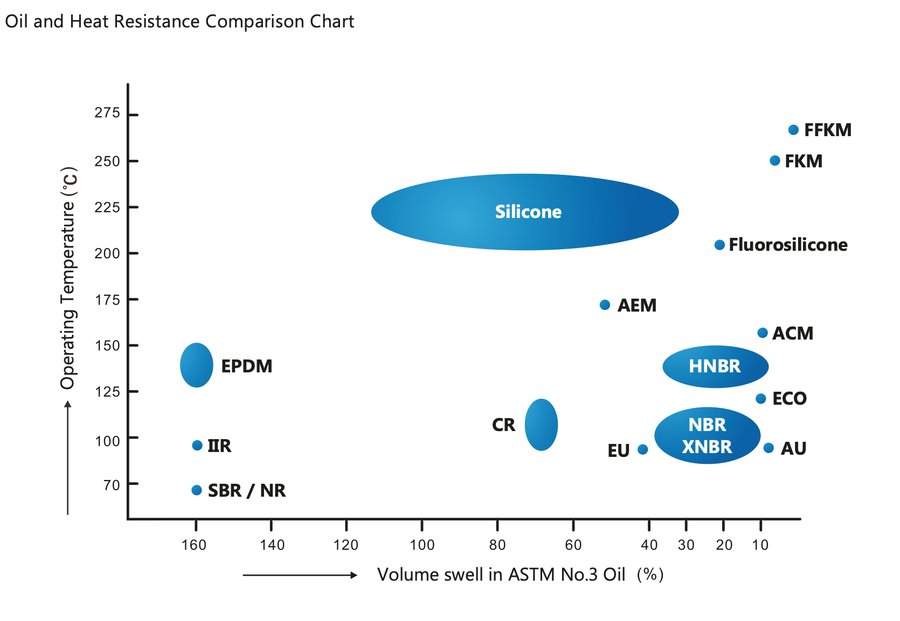
Highest heat + best oil resistance: FFKM and FKM
Across both charts, FFKM and FKM (Viton-type) sit in the top-right zone — highest operating temperature (up to ~250–315°C in special grades) combined with the lowest volume swell in ASTM No.3 oil. Silicone matches their heat resistance but swells heavily in oil, so it's a poor choice where both heat and oil exposure occur together — fluorosilicone (FVMQ) is the better compromise. EPDM, IIR (butyl) and SBR/NR have the weakest oil resistance of the group and should be reserved for water, steam, weathering, brake fluid (EPDM) or dry/gas-only service.
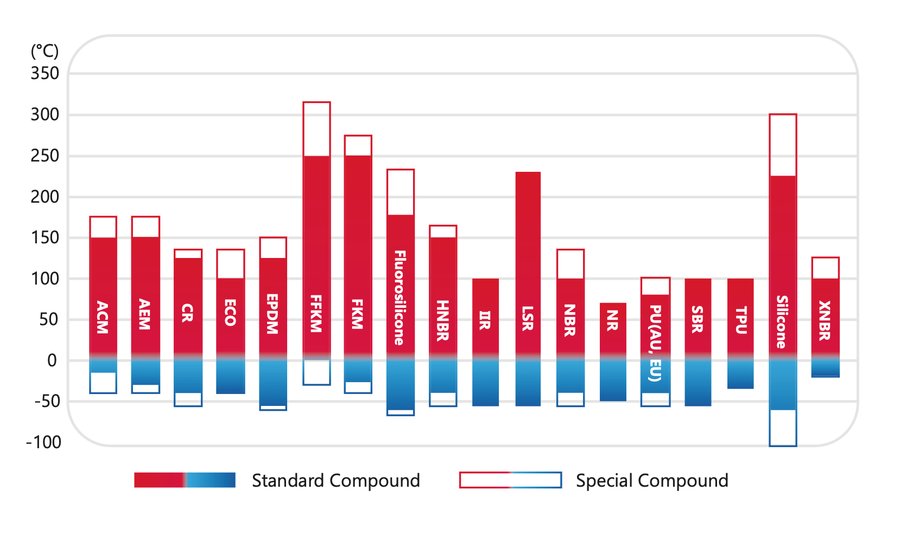
Charts are general reference guides compiled from industry compound data. Actual performance depends on hardness, cure system, additive package and specific fluid/pressure conditions — confirm with FITCO's engineers or the material datasheet before finalizing a spec.
Temperature range & oil resistance by elastomer
The same data as the charts above, in table form.
| Elastomer | Standard compound (°C) | Special compound (°C) | ASTM No.3 oil resistance |
|---|---|---|---|
| FFKM | -5 to 250 | -30 to 315 | Excellent (very low swell) |
| FKM (Viton-type) | -20 to 250 | -35 to 275 | Excellent (low swell) |
| Silicone (VMQ) | -60 to 225 | -100 to 300 | Poor (high swell) |
| LSR (Liquid Silicone) | -55 to 230 | — | Poor (high swell) |
| Fluorosilicone (FVMQ) | -65 to 175 | -70 to 235 | Good |
| AEM | -30 to 150 | -35 to 175 | Good |
| ACM | -15 to 150 | -35 to 175 | Excellent (low swell) |
| HNBR | -40 to 150 | -40 to 165 | Good–moderate swell |
| ECO | -40 to 100 | -40 to 135 | Excellent (low swell) |
| NBR / XNBR | -40 to 100 | -45 to 135 | Good–moderate swell |
| EPDM | -55 to 125 | -60 to 150 | Poor — not oil compatible |
| CR (Neoprene) | -35 to 125 | -50 to 135 | Moderate swell |
| AU / EU (Polyurethane) | -30 to 80 | -45 to 100 | Excellent–moderate swell |
| TPU | -30 to 100 | — | Good |
| IIR (Butyl) | -50 to 100 | — | Poor — not oil compatible |
| SBR / NR | -50 to 70/100 | — | Poor — not oil compatible |
FITCO manufactures NBR, FKM, EPDM, FFKM, HNBR, Silicone, FVMQ, AFLAS and Neoprene O-Rings — see the full materials range →
Common questions
Which O-Ring material has the highest operating temperature?
FFKM, rated up to roughly 315°C in special compounds — followed closely by FKM and silicone.
Which O-Ring material has the best oil resistance?
FFKM and FKM show the lowest volume swell in ASTM No.3 oil. EPDM, IIR and SBR/NR have the weakest oil resistance.
What is the temperature range of NBR O-Rings?
Standard NBR runs -40°C to 100°C; special low-temperature or high-ACN grades extend to about -45°C to 135°C.
Why is silicone a poor choice for oil service despite its heat rating?
Silicone tolerates temperature extremes well but swells significantly in mineral oil — use fluorosilicone or FKM instead where both heat and oil are present.
Not sure which compound fits your application?
Send us your fluid, temperature and pressure conditions — FITCO's engineers will confirm the right elastomer.