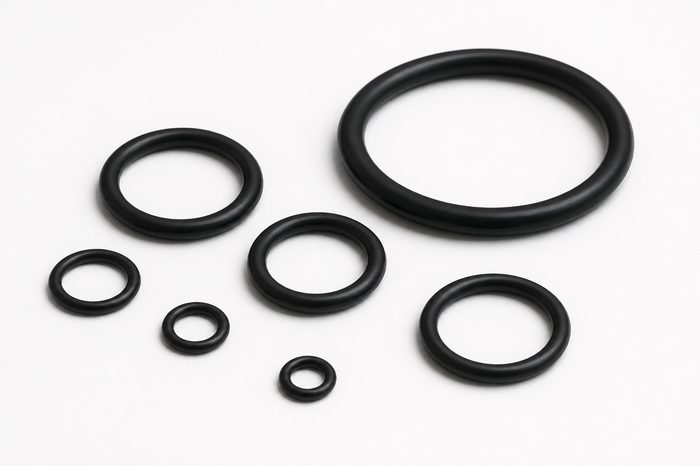
FKM (fluoroelastomer, commonly known by the Viton™ trade name) delivers outstanding resistance to heat, ozone, weathering, and a broad range of aggressive chemicals and hydrocarbons. It is FITCO's standard recommendation for oil & gas wellhead, refinery and high-temperature process sealing where NBR's temperature and chemical range falls short. FKM is supplied at standard 70/90 Shore A hardness (often referenced as "G70"/"G90" grade) as well as by fluorine-content family — see the grade reference below.
| Temperature range | -20°C to +200°C |
|---|---|
| Hardness range | 60–90 Shore A |
| Relative cost | $$$ |
| Resists | Crude oil, aromatic fuels, mineral & synthetic oils, most acids, ozone/UV |
| Avoid with | Ketones, low molecular weight esters, hot water/steam (>150°C), amines |
| Standards | AS568 / ISO 3601 / BS 4518 |
FKM — Fluoroelastomer isn't a single formulation — the grade below matters as much as the base compound once your application gets specific.
The general-purpose FKM family — bisphenol- or peroxide-cured, dipolymer of vinylidene fluoride and hexafluoropropylene. Covers most oil & gas and industrial sealing at the lowest FKM price point; the right default unless a specific fluid or temperature pushes you toward B, F or a specialty grade.
A terpolymer with a third monomer added for higher fluorine content than Type A, giving noticeably better resistance to aggressive lubricants, oxygenated and sour fuels. Common step-up when Type A shows swelling in service.
The highest fluorine content in the standard A/B/F family, giving the best fluid resistance of the three — at the cost of reduced low-temperature flexibility. Specify F-type when chemical exposure is the dominant risk and the seal stays warm in service.
Low-temperature grades developed to retain FKM's heat and chemical resistance while flexing at noticeably colder temperatures than standard Viton. GFLT adds the fluid resistance of F-type on top of GLT's cold performance — the grade to specify for cold-climate oil & gas or aerospace ground equipment.
Peroxide-cure chemistry terpolymer grades with enhanced resistance to steam, acid and aggressive engine oils versus standard bisphenol-cured FKM — frequently specified for automotive engine and steam-adjacent valve seals.
Not sure which sub-grade fits your application? Send us your fluid, temperature and pressure and our engineers will confirm — send an enquiry →
Physical property data — hardness, tensile strength, elongation, compression set and temperature resistance — tested to ASTM/ISO standards for each hardness grade FITCO stocks.
Full physical property data sheet — hardness, tensile strength, elongation at break, compression set and temperature resistance.
Download Datasheet →Full physical property data sheet — hardness, tensile strength, elongation at break, compression set and temperature resistance.
Download Datasheet →General-purpose seal for mineral oils, fuels and hydraulic fluids.
-15°C to +327°CNear-universal chemical resistance for the most demanding process seals.
-40°C to +150°CWater, steam and weather-resistant sealing — the wrong choice for mineral oil.
Compare FKM O-Rings against alternative compounds to confirm you have the right elastomer for your application.
NBR vs FKM Comparison →Select standard, cross-section and ID — get instant OD and material readout for FKM O-Rings.
Open Size Chart →Download the physical property datasheet for this compound — hardness, tensile strength, compression set and temperature resistance.
Download PDFs →Standard FKM covers most high-temperature and chemical-resistant applications. For service conditions beyond FKM's chemical limits, or where assembly friction reduction is required, FITCO also offers FKM-cored FEP encapsulated O-rings and PTFE coated FKM O-rings.
When the fluid list exceeds FKM's chemical capability — concentrated amines, ketones, strong acids at high temperature — an FEP or PFA jacket over a standard Viton FKM core (not specialty sub-grades — standard FKM is the correct core for FEP encapsulation) provides near-universal chemical resistance at the contact surface while the FKM core delivers stronger mechanical recovery than a Silicone core. This combination is specified for:
A thin PTFE coating applied to standard FKM 70, 75 or 90 Shore A O-rings. The FKM base provides high-temperature and chemical resistance; the PTFE coating reduces dynamic friction on slow reciprocating services, prevents adhesion to groove surfaces during long static periods, and eliminates the need for assembly grease on production lines. PTFE coated FKM is particularly valuable in:
General-purpose FKM dipolymer, 66% fluorine. Baseline Viton grade for standard petroleum, mineral oil and general fuel contact.
Viton A details → Enhanced ChemistryTerpolymer, ~68% fluorine. Better resistance to inorganic acids and caustics than Viton A.
Viton B details → Oxygenated FuelsHigh-fluorine terpolymer (~70%). Engineered for ethanol/biodiesel blends and oxygenated automotive fuels.
Viton F details → Cold ClimateLow-temperature FKM to −40°C. Cold flexibility without sacrificing chemical resistance.
GLT/GFLT details → High-Pressure GasAnti-Explosive Decompression grade. High-hardness FKM for rapid gas decompression service.
AED details → Extreme ChemistryMaximum amine, high-pH and broad chemical resistance beyond standard FKM capability.
Viton Extreme details →Send us your fluid, temperature and pressure — our engineers will confirm the compound.