
FEP Encapsulated O-Rings — Chemical Resistance of PTFE, Flexibility of Rubber
FITCO manufactures FEP and PFA encapsulated O-rings with a Silicone or Viton (FKM) elastomer core, jacketed in a seamless fluoropolymer sheath. The result: near-universal chemical resistance with the elastic recovery and sealing force rubber provides — addressing the single biggest limitation of solid PTFE O-rings.
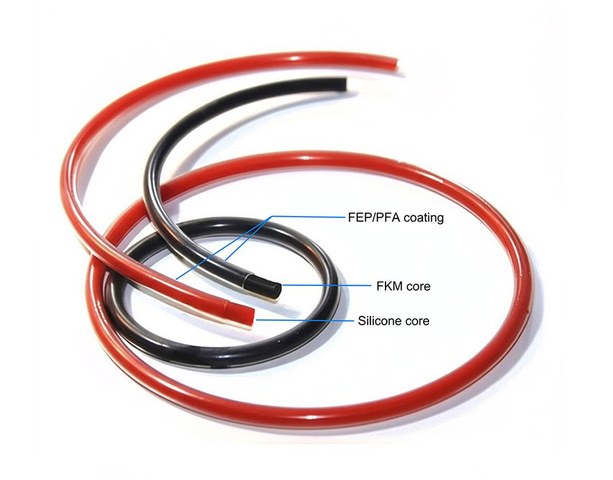
PTFE's chemistry. Rubber's function.
A solid PTFE O-ring resists almost every chemical — but PTFE has very low elastic recovery. Compress it, release the load, and it doesn't spring back reliably. That makes a solid PTFE O-ring a poor dynamic seal and a limited static seal that requires frequent re-tightening.
An FEP (or PFA) encapsulated O-ring solves this: the fluoropolymer jacket provides the chemical inertness of PTFE, while the rubber core (Silicone or Viton FKM) provides the elastic memory to maintain sealing force under compression cycling and temperature fluctuation.
| Property | FEP/PFA Jacket | Core Options |
|---|---|---|
| Chemical resistance | Near-universal (PTFE-equivalent) | — |
| Temperature range | FEP: −200°C to +200°C | Silicone core: −60°C to +200°C Viton core: −20°C to +200°C |
| Elastic recovery | Low (fluoropolymer jacket) | Silicone: excellent Viton: very good |
| Compression set | Jacket deforms permanently | Core resists set — maintains force |
| Sealing pressure | Static and low-pressure dynamic sealing | |
| FDA compliance | FEP and PFA both FDA-approved | FDA Silicone core available |
Silicone core vs Viton core
FEP / PFA over Silicone Core
Silicone's exceptional temperature range (−60°C to +200°C) and FDA/USP Class VI compliance makes this the standard for pharmaceutical, food processing, cryogenic and wide-temperature-cycle applications. Silicone also has lower compression set than Viton at low temperatures, keeping the seal active at −40°C and below.
Silicone material details →FEP / PFA over Viton (FKM) Core
Viton FKM provides stronger mechanical recovery than silicone, making this combination better for moderate dynamic service and applications where the fluid contact is exclusively through the fluoropolymer jacket but where the seal sees pressure cycling or intermittent movement. Viton also handles steam better than silicone at the upper temperature range.
FKM material details →Where FEP Encapsulated O-Rings are specified
Aggressive Acid & Solvent Service
Concentrated mineral acids (HF, HCl, H₂SO₄), strong oxidisers, ketones, esters and chlorinated solvents that attack any rubber compound — even FFKM in extreme cases. The FEP jacket remains inert; the rubber core maintains sealing force.
Sterile & CIP/SIP Systems
Clean-in-place and steam-in-place validated systems where extractables from the seal itself are a regulatory concern. FEP + FDA Silicone core meets USP Class VI, FDA 21 CFR and EU 10/2011 requirements.
Food Contact & High-Purity Fluids
Dairy, beverage and high-purity food processing where both the chemical contact surface and the seal elasticity must meet food-grade standards. FEP does not impart taste, odour or extractables.
Ultra-Pure Chemical Handling
Wet bench chemistry, acid dispensing systems and ultra-pure water circuits where even FKM or FFKM elastomer extractables are unacceptable. The FEP jacket is the contact surface; no elastomer contacts the process fluid.
Sour Gas & Mixed Chemical Exposure
When the fluid list is too broad for a single elastomer compound — mixed acid gases, amines, solvents plus hydrocarbons — an FEP-jacketed O-ring with Viton core covers the combination that no single elastomer can.
Sub-Zero & Wide-Cycle Sealing
FEP + Silicone core maintains sealing function from −60°C — significantly colder than Viton (−20°C limit) or FFKM (−15°C limit). Used in LNG, liquid nitrogen and cryogenic chemical handling equipment.
FEP Encapsulated O-Ring specification reference
| Jacket Material Options | |
|---|---|
| FEP (Fluorinated Ethylene Propylene) | Standard jacket — −200°C to +200°C |
| PFA (Perfluoroalkoxy) | Higher purity, better for hot aggressive acids — −200°C to +260°C |
| Core Material Options | |
| Silicone (VMQ) | −60°C to +200°C · FDA/USP Class VI available |
| Viton (FKM) | −20°C to +200°C · Higher mechanical recovery |
| Size Range | |
| AS568 sizes | -006 to -475 (confirm availability per size) |
| Metric sizes | ID 2mm+ · CS 1.5mm, 2.0mm, 2.5mm, 3.0mm, 4.0mm, 5.0mm |
| Custom sizes | To drawing — confirm with FITCO |
FEP O-Rings are static or low-pressure dynamic seals
The fluoropolymer jacket has limited elastic recovery compared to a solid rubber O-ring. FEP encapsulated O-rings are optimised for static sealing (flanges, pipe joints, reactor lids) and low-pressure slow-cycle dynamic applications. High-speed reciprocating or rotary dynamic service requires FFKM.
Groove dimensions differ from standard O-ring glands
The jacket adds to the overall cross-section. Groove design should account for the combined jacket + core dimensions — do not use standard O-ring gland dimensions without confirming FEP O-ring compression percentage. FITCO can provide groove design guidance with each order.
Other specialty sealing products
PTFE Coated O-Rings
Thin PTFE coating over standard elastomer — low friction, chemical surface protection, food-grade compliance.
MaterialFFKM — Perfluoroelastomer
Solid rubber alternative to FEP-encapsulated where dynamic service or high pressure rules out the jacketed design.
Core MaterialSilicone (VMQ)
FDA and USP Class VI grades — the standard core for pharmaceutical and food-grade FEP O-rings.
Core MaterialFKM — Viton-type
Higher-strength FKM core for FEP O-rings in chemical processing and oil & gas applications.
Send FEP O-Ring Requirement
Share the jacket type (FEP/PFA), core (Silicone/Viton), size (AS568 dash or ID × CS in mm), and quantity — our engineers will confirm availability and pricing.