For glands larger than standard O-ring sizes, or non-circular gasket runs, FITCO extrudes cord stock in 2mm to 16mm cross-sections and supplies it by the metre — cut straight or spliced into a finished, jointed ring.
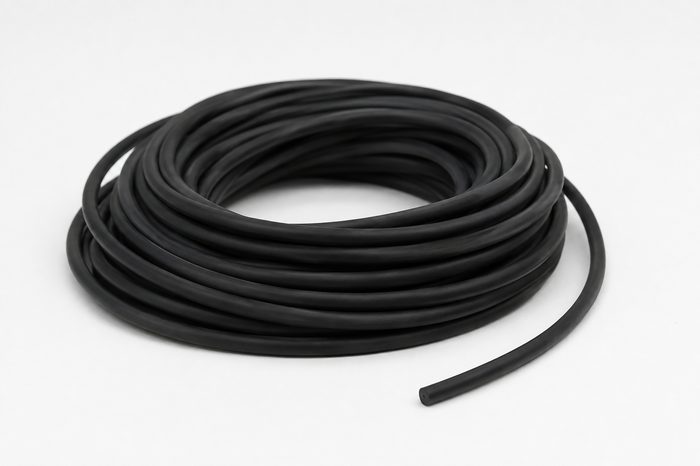
Sealing cord is the same elastomer used in a molded O-ring, extruded as continuous stock instead of cured into a fixed-size ring. It exists for two situations a standard O-ring catalog can't cover: glands larger than any standard dash size, and non-circular seal paths — rectangular covers, custom-shaped access panels, irregular flange perimeters — where a molded round ring simply doesn't fit the geometry.
Cord is either cut to a straight length for a linear gasket run, or spliced (hot- or cold-bonded at the ends) into a closed loop sized to your exact internal circumference — effectively a made-to-order O-ring at any diameter, without paying for a dedicated mold.
| Your situation | Start with |
|---|---|
| General oil-exposed gasket run | NBR |
| Outdoor enclosure or weatherproofing seal | EPDM |
| Food-grade or high/low temperature enclosure | Silicone |
| Hot oil, fuel or chemical exposure | FKM |
Full compound detail is on our Materials page.
Cord is supplied as continuous stock or spliced into a finished ring — specify a required internal length or gland ID in your enquiry message if splicing to a closed loop.
Most common profile — spliced into a continuous loop for custom gland sizes larger than standard O-rings, or used as running length for gaskets.
Used where a flat sealing face is needed, or as a low-cost alternative to molded rectangular-section seals.
D-, U- and application-specific extruded profiles — supply a drawing or sample for tooling.
High-temperature, chemical-resistant sealing for oil & gas and process industries.
Material detail →-30°C to +100°CGeneral-purpose seal for mineral oils, fuels and hydraulic fluids.
Material detail →-60°C to +230°CFood-, medical- and electrically-safe sealing across a wide temperature band.
Material detail →-40°C to +120°CGeneral-purpose weather- and ozone-resistant rubber with moderate oil resistance.
Material detail →-30°C to +150°CHigher heat and abrasion resistance than standard NBR for demanding drives.
Material detail →-40°C to +150°CWater, steam and weather-resistant sealing — the wrong choice for mineral oil.
Material detail →They're the same elastomer — cord is extruded continuous stock rather than molded into a fixed ring, so it can be cut or spliced to any length or diameter a standard O-ring size chart doesn't cover.
Yes — FITCO splices cord ends (hot- or cold-bonded) into a closed loop sized to your exact internal circumference, effectively a made-to-order O-ring without a dedicated mold.
2mm through 16mm in 0.5mm increments up to 10mm, then whole-mm steps to 16mm — across FITCO's six sealing cord compounds (FKM, NBR, Silicone, Neoprene, HNBR, EPDM).