
PTFE Coated O-Rings — Low Friction, Chemical Surface Protection, Easy Assembly
FITCO manufactures PTFE (Teflon) coated O-rings — a standard rubber O-ring with a thin, applied PTFE coating on the outer surface. The coating reduces friction on assembly and dynamic surfaces, adds a thin chemical barrier, and gives the O-ring a smooth, dry, non-stick finish that prevents sticking in grooves and eases installation without grease.
Same rubber. Better surface.
A PTFE coated O-ring is not an encapsulated O-ring — the PTFE is a thin surface coating (typically 0.01–0.05mm) applied over a fully-formed standard rubber O-ring, rather than a thick seamless fluoropolymer jacket. The base elastomer retains all its sealing properties, compression set behaviour and dimensional characteristics. The PTFE coating modifies only the surface: reducing friction coefficient, providing a thin chemical barrier, and giving a consistent dry lubrication that eliminates the need for assembly grease in many applications.
| Property | PTFE Coated O-Ring | Uncoated O-Ring |
|---|---|---|
| Assembly friction | Significantly reduced (dry slip) | Higher — may need grease |
| Chemical surface resistance | PTFE barrier (thin, not absolute) | Elastomer-dependent |
| Non-stick / release | Does not stick in groove | Can stick after long static service |
| Sealing performance | Unchanged from base elastomer | Base elastomer only |
| Dynamic friction | Lower — suits slow reciprocating | Higher |
| Temperature limit | Set by base elastomer (PTFE withstands higher) | Base elastomer only |
| FDA compliance | PTFE is FDA-approved; FDA core compound needed | Compound-dependent |
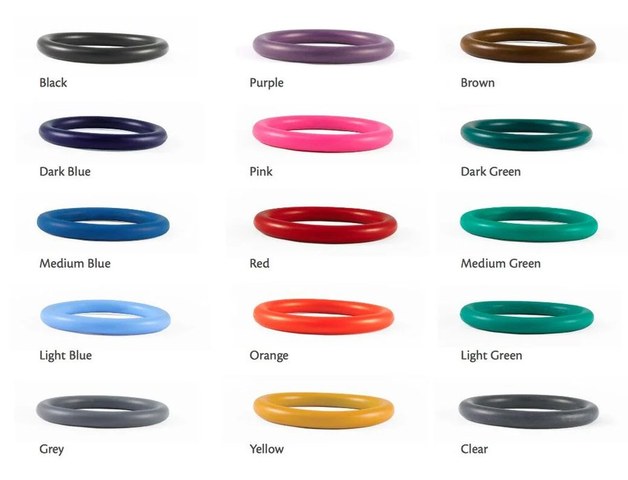
PTFE coating over any standard compound
FITCO applies PTFE coating to O-rings in all major elastomer compounds — the base material is selected for chemical and temperature compatibility with the process, and the PTFE coating is applied for surface and assembly performance.
PTFE coated NBR
The standard specification for hydraulic and pneumatic cylinders where dry assembly, reduced stick-slip and elimination of assembly grease are the main drivers. NBR 70 or NBR 90 base with PTFE surface.
PTFE coated Silicone / EPDM
For food contact and pharmaceutical applications where the FDA-grade elastomer core provides the sealing chemistry and the PTFE coating provides a compliant, non-stick, non-extractable surface that cleans easily and doesn't transfer material to the process.
Where PTFE coated O-rings are specified
Dry Assembly Cylinders
Pneumatic cylinder assemblies where grease contamination of the working fluid is unacceptable, and where the O-ring must slip into the groove and over pistons without tearing or rolling. PTFE coating replaces the grease application step on the production line.
Fuel & Engine Assembly
O-rings assembled into fuel injectors, fuel rail connections and engine components often specify PTFE coating for consistent dry assembly on high-speed production lines, where applying grease introduces a process variable and potential contamination.
Grease-Free Medical Assembly
Medical device assemblies where regulatory approval covers the seal material but not an additional assembly lubricant — PTFE coated O-rings allow lubrication-free assembly that remains within the validated material set.
Non-Stick Food Contact Seals
PTFE coated FDA Silicone or EPDM O-rings for valves and equipment in food processing where the seal must not transfer flavour, colour or residue, and where product adhesion to the seal face between cycles is a cleaning concern.
Surface Chemical Barrier
Where the base elastomer (typically FKM or EPDM) is correct for the bulk process fluid but a brief surface contact with a cleaning agent, acid wash or disinfectant cycle would otherwise cause surface degradation — the PTFE coating provides a thin protective barrier.
Anti-Stick in Grooves
O-rings in static sealing joints (flanges, covers) that are opened infrequently can bond to the groove surface. PTFE coating prevents adhesion, making the O-ring easier to remove without damage during maintenance — particularly important for FKM O-rings in process equipment.
PTFE Coated O-Ring specification reference
| Coating | |
|---|---|
| Coating material | PTFE (Polytetrafluoroethylene) |
| Coating thickness | 0.01–0.05mm typical (thin surface film) |
| Application method | Tumbled / spray applied — uniform coverage |
| FDA compliance | PTFE is FDA 21 CFR compliant |
| Dimensions | |
| Size range | AS568 full range · Metric/ISO 3601 · Custom |
| Dimensional effect | Coating adds ≤0.05mm to cross-section — confirm gland clearance on tight-tolerance designs |
| Standards | |
| Size standards | AS568, ISO 3601, BS 4518, GB/T 3452.1, JIS B2401 |
| Core compound standards | Per base elastomer — ASTM D2000, ISO 4639 |
Choosing between the two
| Factor | PTFE Coated | FEP Encapsulated |
|---|---|---|
| Chemical resistance | Surface only (thin film) | Full fluid contact via jacket |
| Dynamic sealing | Slow reciprocating — good | Static preferred |
| Cost | Lower | Higher |
| Groove design | Standard O-ring gland | Modified groove needed |
| Friction reduction | Significant | Moderate |
| FDA compliance | Core + PTFE both needed | FEP jacket + core both FDA-approved |
Use PTFE coated when the elastomer base is chemically compatible and you need friction reduction or assembly ease. Use FEP encapsulated when the process fluid is too aggressive for any rubber and the fluoropolymer must be the actual contact surface.
FEP Encapsulated O-Rings →Specialty sealing products
FEP Encapsulated O-Rings
Full fluoropolymer jacket over Silicone or Viton — near-universal chemical resistance.
ProductPTFE Back-up Rings
Anti-extrusion PTFE rings paired with O-rings in high-pressure gland designs.
Common BaseNBR — Nitrile
Most common base elastomer for PTFE coated O-rings in hydraulic and pneumatic service.
ToolCustom O-Ring Sizes
PTFE coated O-rings available in custom sizes — enter ID × CS and specify PTFE coating on enquiry.
Send PTFE Coated O-Ring Requirement
Specify base compound, PTFE coating, size (AS568 dash or ID × CS mm) and quantity. Our engineers will confirm grade and pricing.